
How to Search Criminal Dockets
Alabama's Just One Look service is the official remote route for a Coffee County Circuit or District criminal docket. It sells access on demand. There is no free county database behind it. Use a full case number whenever you can, since it narrows the result at once. A name search works, but matches can be shaky. Before paying for case detail, confirm the result lists Coffee County, the right division, the right court level, and the filing year you expected.
When remote access stalls, contact the Coffee County Circuit Clerk. The office can route a public criminal court record through its Enterprise or Elba division, explain how to inspect a file, quote an available copy, and take a narrow written request. Municipal dockets are different. Ordinance and misdemeanor cases stay with the city court, so check which court issued the notice or citation first. That check saves a wasted trip.
- Identify Circuit, District, or municipal court from the notice, charge, or case prefix.
- Check the Enterprise or Elba division and search the exact case number in Just One Look.
- Confirm the Coffee County case style, filing year, court, and charge before opening detail.
- Read entries in date order, then check the newest setting, plea, disposition, and sentence.
- Ask the proper clerk for the named indictment, order, or certified copy when the docket index is not enough.
Coffee County Criminal Docket Portal
Just One Look searches Alabama State Trial Court Records by name or case number. The fee is set on its live entry screen. Payment buys what the service can show: setting dates, court actions and rulings, party detail, case-action summaries, financial information, and available attachments. Query controls beyond the entry point stay closed. Do not assume a filter that the public screen never offered.
AlacourtACCESS is separate. It is a professional login service. AlaFile serves a different job, letting registered users transmit filings into the state system. Neither is a free Coffee County criminal docket reader. When the paid screen does not help, call the Circuit Clerk at the division on the papers, stop at that counter, mail a focused request, or ask whether older material needs archive retrieval.
What a Criminal Docket Shows
A Coffee County criminal docket usually opens with the basics. Look for the court and division, case number, filing date, the State-versus-defendant style, judge, and charge information. The case-action record then indexes what came next: warrants or complaints, an indictment if one exists, attorney appearances, bond activity, notices, settings, pleas, rulings, disposition, sentence, costs, and appeal activity. Remember what it is not. It indexes events. It does not record testimony or proof.
| Case number | A Coffee County criminal code such as CC for Circuit criminal or DC for District criminal, followed by year and sequence in the official format. |
|---|---|
| Charge | The allegation, statute, and classification when public; a charge line is not a finding of guilt. |
| Bond | Type, amount, and status when public, kept separate from the final case outcome. |
| Settings | Arraignment, pretrial, plea, trial, sentencing, or review dates, subject to later resets. |
| Disposition | The recorded result, such as dismissal, nolle prosequi, acquittal, or conviction, followed by sentence and appeal entries where applicable. |
Coffee County Criminal Docket Codes
Case type is the fastest clue to where a Coffee County criminal record sits. CC marks a Circuit criminal case. DC marks a District criminal case. The full number usually adds a year and a sequence, but Coffee County publishes no sample format, so do not copy the pattern from another county's record.
- Arraignment
- The appearance at which charges and a plea are addressed.
- Bond forfeiture
- A bond-related consequence, often tied to appearance, not the final ruling on the charge.
- Nolle prosequi
- The prosecution's formal decision not to proceed on a charge, subject to court procedure.
- Disposition
- The recorded outcome of the charge or case.
Read each term in order. A bond forfeiture on a Coffee County criminal docket does not mean a conviction. A dismissal or nolle prosequi is not one either. When an entry only says a motion or order was filed, pull the actual paper before deciding what the judge ruled.
Stages on a Criminal Docket
A felony often starts in District Court. Expect entries there for the complaint, warrant, initial appearance, bond, and preliminary hearing. A grand-jury indictment then lifts the felony into Coffee County Circuit Court. Misdemeanors normally stay put at the District level. Only a later appeal builds a Circuit record. Along the way, the chronological register can pick up motions, discovery entries, notices, and changes to a scheduled date.
Docket flow: Filing › Arraignment › Pretrial › Plea or Trial › Disposition › Sentencing
That last line may not be the last entry. Post-judgment motions and an appeal can follow sentencing. Read to the newest date. An old setting is not current if a later continuance, reset, or order changed it.
Coffee County Felony Docket Path
One felony can leave two Coffee County criminal dockets that look unrelated. The early record, holding probable-cause and bond events, sits in District criminal court. Once the grand jury indicts, the Circuit Court record takes the felony through arraignment, plea or trial, disposition, and sentence. A name and charge alone are not enough. Match the court too. Also compare case type, filing year, and related entries.
An indictment may appear as a listed entry without its text. Note the entry's date and title. Then ask the Coffee County Circuit Clerk whether the filed document is public and electronically imaged. Say if you need it certified. Coffee County posts no copy-price table, archive fee, or fixed turnaround, so get a quote before sending payment.
Which Court Holds Criminal Dockets
Coffee County's criminal cases split across several courts, so knowing the layer matters before any docket search. Felonies live in Coffee County Circuit Court once an indictment returns, and that court hears appeals too. The Coffee County District Criminal division takes the smaller stuff: misdemeanors, warrants, and early felony steps. Enterprise, Elba, and Kinston each run a municipal court with its own ordinance dockets. New Brockton is different. Its town code sends criminal prosecutions to Coffee County District Court, Enterprise Division.
That map should guide every lookup. Just One Look promises statewide trial court access. But a promise of coverage is not proof that every municipal record made it in. For a city matter, start with the municipal clerk. A Circuit or District case belongs to the Coffee County Circuit Clerk. Probate has no criminal search desk. The District Attorney does not keep the court records.
Coffee County Criminal Docket Offices
Two clerk offices serve the county. The official Coffee County court site lists both. The Enterprise Division sits at 101 South Edwards Street, Enterprise, AL 36330, phone (334) 347-2519. The Elba Division is at 230-M Court Avenue, Elba, AL 36323, at (334) 897-2954. Both keep Monday through Friday hours, 8:00 a.m. to 4:30 p.m. They close only on listed legal holidays.
A docket entry may not name the division. Call ahead. Old paper files may not be scanned either. Whether you visit, call, or mail a request, have the case number ready in State-versus-defendant form. Add the rough filing year, the court, and the exact document you want. For mail, ask the right division what payment and return materials it requires. Clerk staff can explain record access, though not legal advice.
Coffee County Criminal Docket Routing
A docket search can come up empty. That often points at the wrong office, not a vanished case. An ordinance charge from Enterprise, Elba, or Kinston can stay in municipal court the whole way. County misdemeanors belong to District Court. A felony may leave a District stage behind. It can then surface later as a Circuit case. Always start with the court printed on the citation, bond paper, notice, or charging document.
If no match appears: check the spelling and year, confirm Enterprise or Elba, identify municipal versus District jurisdiction, call the correct clerk, then ask about a narrow archive search.
A failed name search does not mean the Coffee County criminal docket was sealed. Check the ordinary culprits first: wrong venue, wrong case prefix, wrong division, or an older record never digitized. Those are far more common.
Public Access and Sealed Criminal Dockets
Public Coffee County criminal court records still answer to Alabama confidentiality law and judicial rules. Juvenile matters get no ordinary public access. Youthful-offender records stay closed unless the statute allows otherwise. A court can seal a record. Alabama's criminal expungement law changes both access and how the record is handled. A public-record request cannot push past any of that.
The Alabama Rules of Court-Record Privacy and Confidentiality took effect in 2025 and control redaction, sealing, access, and fees for covered records. Protected identifiers and restricted material can come out while the rest of the docket stays public. Getting at restricted content generally takes legal authority or a court order.
Key rules:
Ala. Code § 36-12-40 provides an inspection and copy right for public writings, subject to exceptions.
Ala. Code § 15-19-7 restricts public inspection of youthful-offender records.
Alabama Title 15, Chapter 27 begins the state's criminal expungement framework.
Coffee County Restricted Criminal Dockets
Alabama's youthful-offender statute sets one hard boundary on public Coffee County criminal dockets. The Alabama Legislature's source for that rule spells out what the law keeps from view.
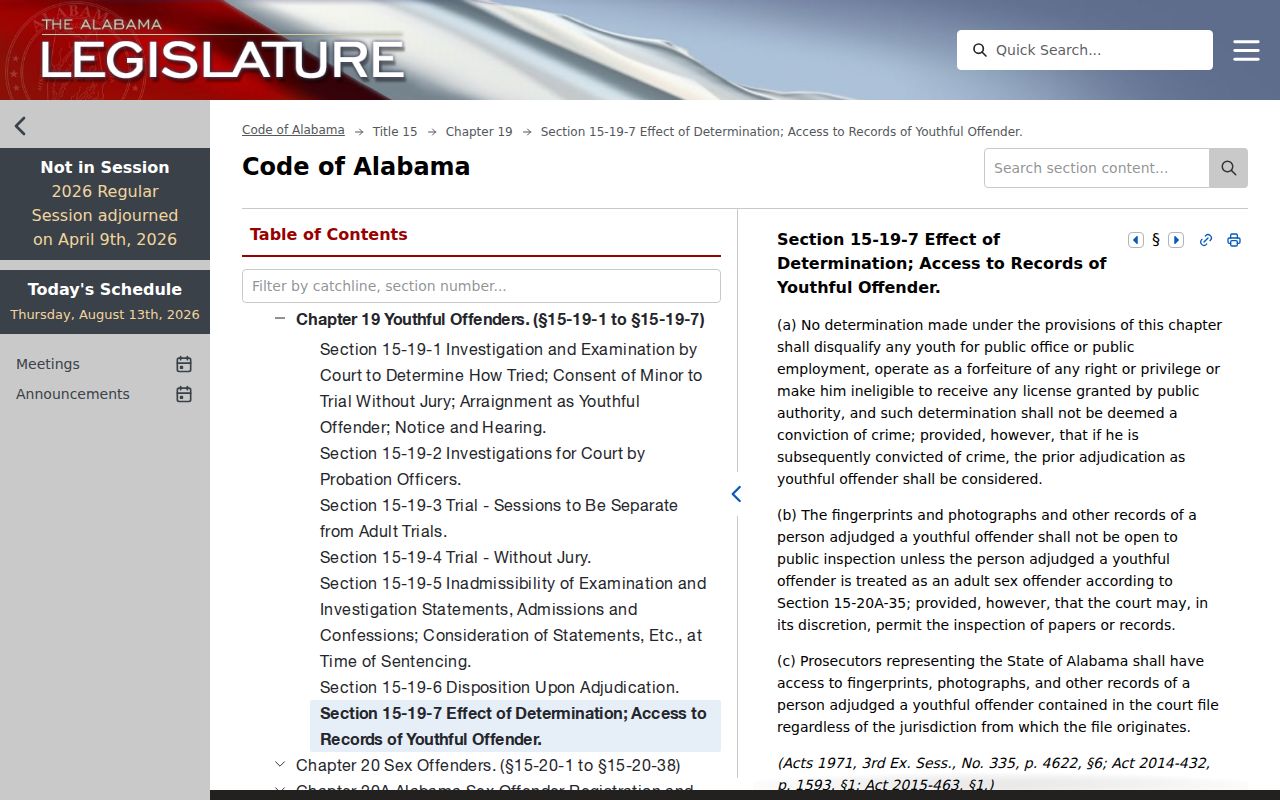
Sparse public detail is not proof that nothing happened in a case. Authorized access runs through the clerk and the governing law. That is the whole story the statute tells.
Expungement works under a separate set of rules entirely. The official Alabama criminal expungement chapter lays out that framework.
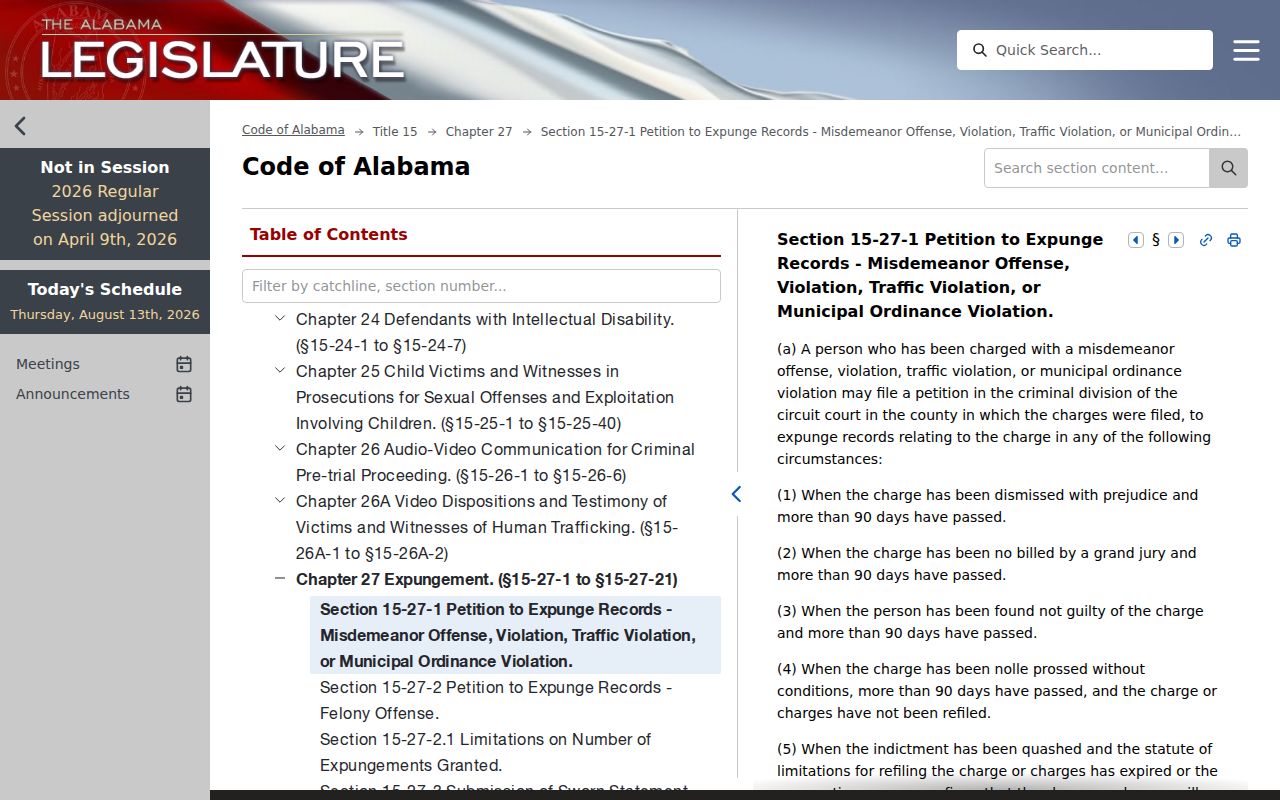
An online gap, by itself, cannot show that a Coffee County case was expunged. Rule out ordinary search and custody problems first, then draw conclusions.
Coffee County Criminal Docket Trends
Alabama's own court statistics give scale, though they never explain why counts moved. Coffee County Circuit criminal filings dropped from 1,202 in fiscal year 2019 to 564 in fiscal year 2023. That is a fall of about 53 percent. Circuit Court also recorded 698 criminal dispositions in fiscal year 2023. These are workload counts only. They measure neither guilt, delay, nor public safety.
The same numbers show why the court layer matters in any search. District Court carried a much larger total docket spanning criminal, traffic, civil, juvenile, and other work. A Circuit-only search cannot stand in for the full Coffee County criminal docket.
Coffee County Federal Criminal Dockets
A federal criminal case touching Coffee County will not sit in the state Circuit Clerk's docket. It goes to federal court instead. The county falls in the Southern Division of the U.S. District Court for the Middle District of Alabama. Federal filings run through CM/ECF, and public federal docket access runs through PACER. That means a separate custodian, a different case-number system, and its own fees. The Middle District CM/ECF entry point is where that federal system begins.
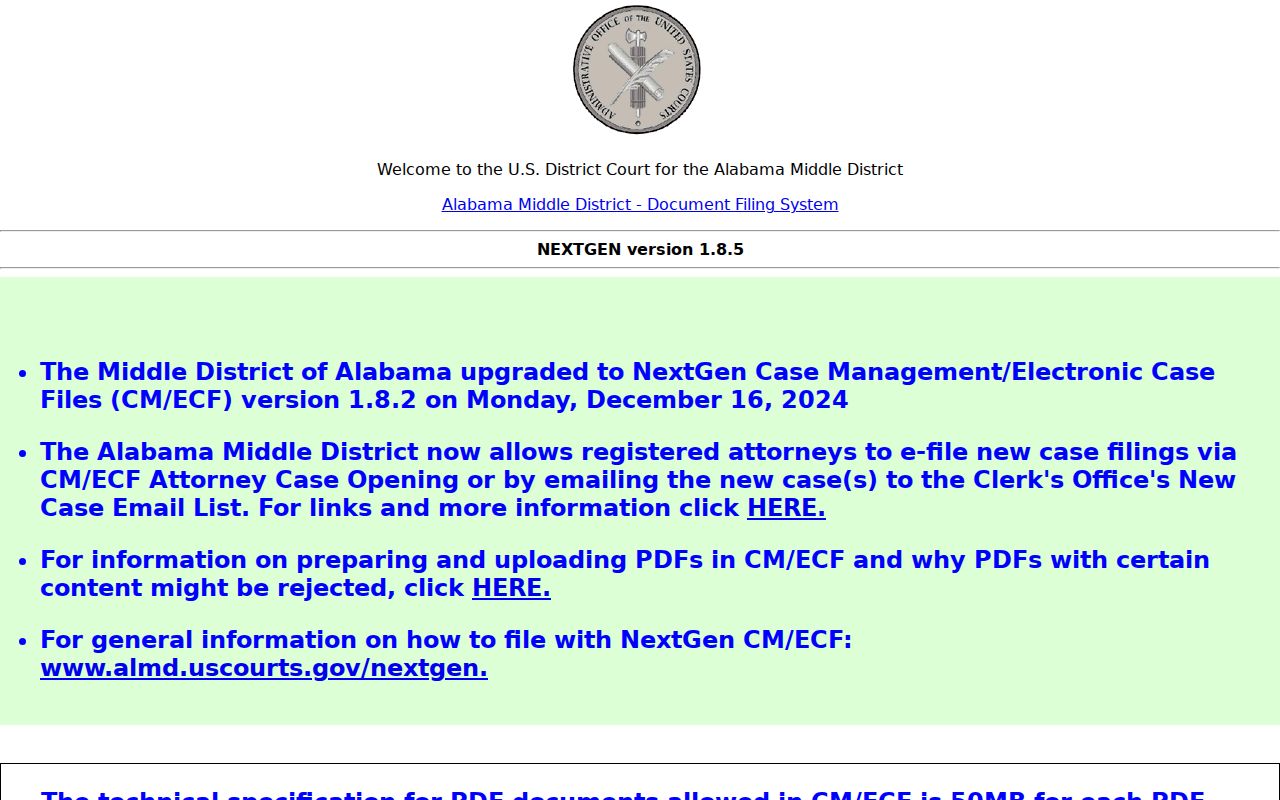
The split is jurisdictional at heart. State Coffee County criminal dockets stay with Alabama trial courts, while federal docket reports and filings live in the federal system.